


Single Stair Buildings in DC: What the One Front Door Act Changes

What Happened
DC just took a significant step toward enabling taller single stair buildings across the city. In May 2026, the DC Council unanimously approved the One Front Door Act, introduced by Councilmember Brianne Nadeau. The legislation directs the DC Department of Buildings (DOB) — now the rulemaking authority following the sunset of the Construction Codes Coordinating Board — to establish new building code standards that would allow multifamily residential buildings up to six stories to operate with a single shared staircase and entrance. That doubles the current three-story limit, which has been on the books for decades.
This legislation doesn’t immediately change the building code – it sets the rulemaking in motion. DOB has until July 2027 to adopt new code standards. In the new codes they will need to address travel distance to the stair, fire suppression, smoke management, ventilation, and a most likely cap of four units per floor. Though they do have some flexibility to implement what it sees fit. That process will require meaningful engagement with DC Fire and EMS — as they have been the biggest voice of dissent around this movement. We do welcome this engagement to address their concerns while still finding common ground to propel this change forward.

Single Stair Buildings in DC – Walkable Neighborhoods
Earlier this week, we spoke at the District Architecture Center alongside Stewart Schwartz of the Coalition for Smarter Growth and Thomas Long of Torti Gallas + Partners, at an event organized by AIA|DC’s Housing the Region Committee, CNU Mid-Atlantic, and the Coalition for Smarter Growth. The evening brought together architects, planners, developers, and advocates to discuss how this typology can support more walkable, neighborhood-scale growth across the Washington region.
Where Single Stair Buildings Fit in DC
When we wrote about single stair buildings last year, the One Front Door Act was still pending. Now that the Council and Mayor have acted, the question shifts to implementation: what will these buildings actually look like on the ground, and where can they go?
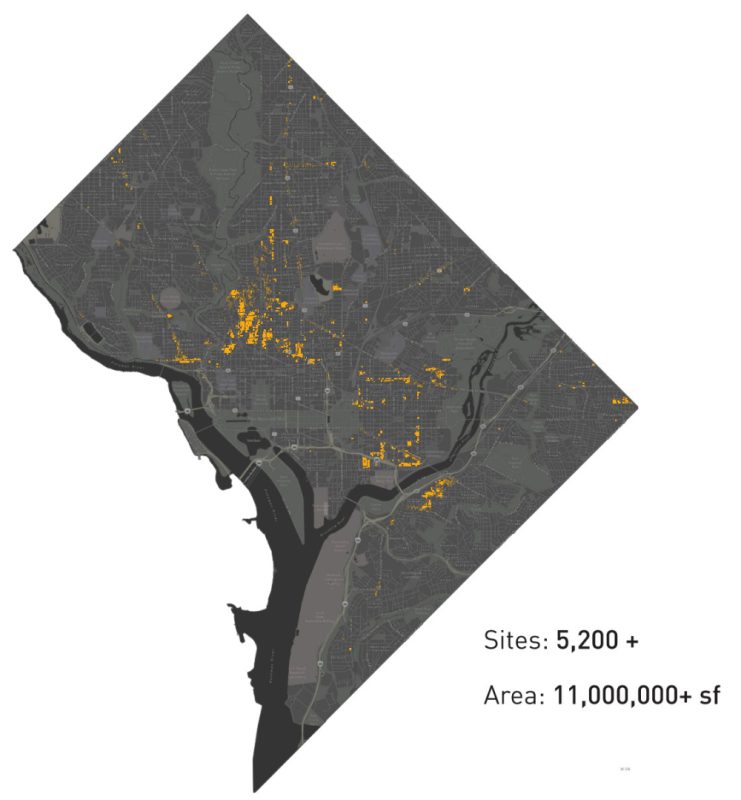
single stair in DC – potential sites
We’ve been developing a design research framework we call SINGLECORE — a study of the single-stair building typology as a specific tool for DC’s urban infill context. As part of that research, we identified more than 5,200 eligible sites across the District — in RA, MU, and NMU zones along corridors like Rhode Island Avenue, Georgia Avenue, Kennedy Street, and 14th Street — representing over 11 million square feet of potential development area. These are often narrow, odd-shaped, or underbuilt lots that have long resisted conventional multifamily development due to the code requirement to provide two stairs making them difficult to pencil out financially. The SINGLECORE typology provides a solution for these sites where a double-loaded corridor layout simply doesn’t work.
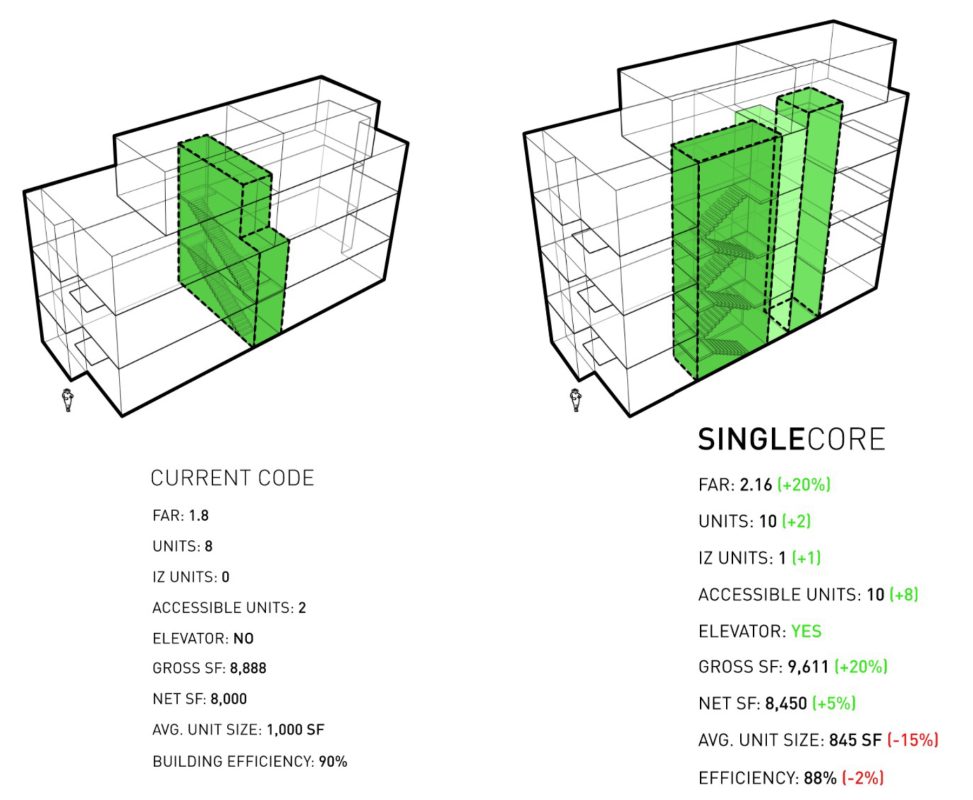
single stair in DC – SINGLECORE Buildings
To understand the practical difference, we studied three specific DC sites. At 4347 Harrison Street NW, a 3,260 sf lot in an RA-2 zone, a SINGLECORE building produces two additional units over current code — going from 8 to 10 — while adding full elevator access and bringing all units up to accessible standards. That last point is significant: the current zoning and market constraints only yields 2 accessible units; the SINGLECORE scenario yields 10 and an affordable Inclusionary Zoning Unit – that otherwise wouldn’t be built in this zone. At 824 Upshur Street NW, a larger MU-4 lot, the typology trades unit count for unit size — 20 larger, family-sized units with 63% more average area and 10% more net square footage than the conventional 30-unit scenario on the same gross building area.
The takeaway is that the SINGLECORE concept is a significant, even if incremental, improvement to the by-right development potential of these lots. Which, in this tight economic environment, might make the difference between a project being financially viable or not. Or more directly the difference between housing units being constructed or not.
What Comes Next
The One Front Door Act is the beginning of the implementation process. As mentioned earlier, DOB has until the summer of 2027 to write and adopt the new standards. We implore the design and development community to stay engaged as that work unfolds. AIA|DC’s Advocacy Committee has been instrumental in advancing this legislation, providing both written and oral testimony in support of the act. Continued involvement in the rulemaking will help ensure the resulting standards are both workable and safe.
In the meantime, infill sites that were previously too narrow for conventional multifamily are worth a second look. Understanding the likely footprint, unit mix, and massing implications of a SINGLECORE building on a given lot can inform decisions before the rulemaking concludes. Similar legislation is advancing in Virginia and Maryland, which suggests a broader regional shift may be taking shape.
Single stair buildings won’t be the right fit for every site or every program. But for DC’s inventory of narrow urban parcels, SINGLECORE represents one of the most practical tools available for delivering more housing at a neighborhood scale – including what would be considered “missing middle housing“.
Are you looking at a property that you think might benefit from this change? We can help you think through that – get in touch!
